Sandra Buckingham
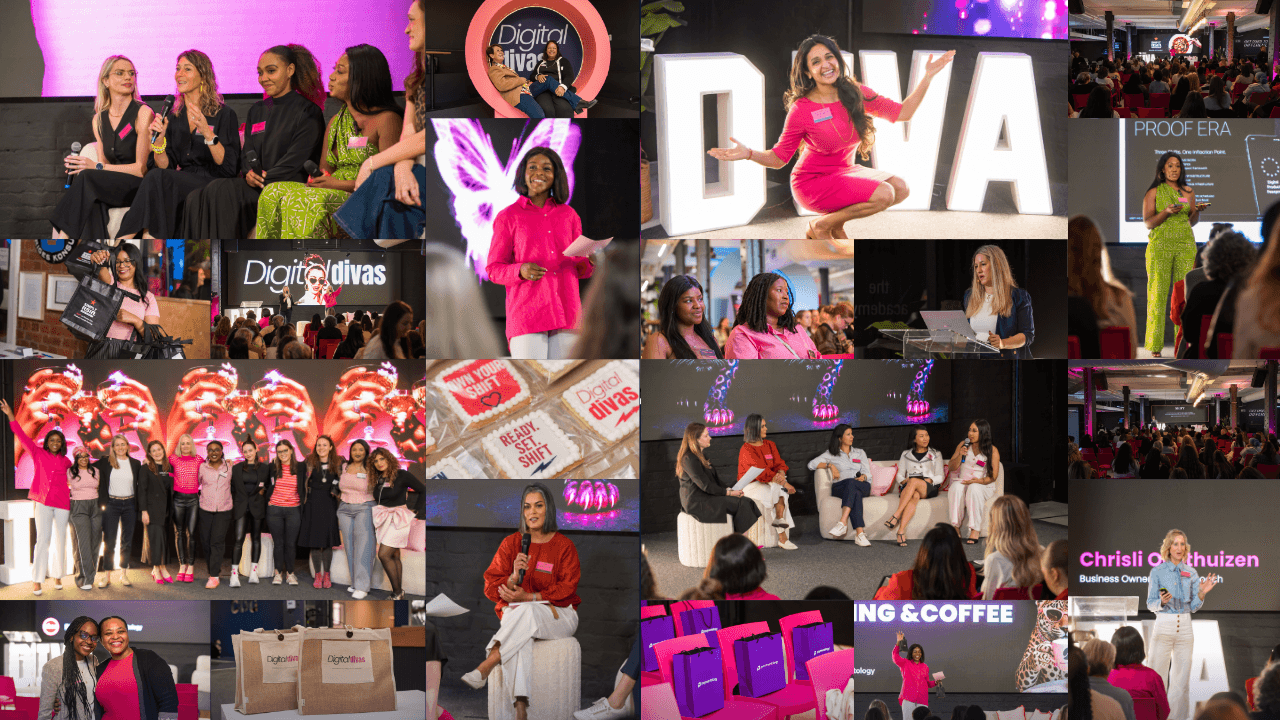
AI may be changing the tools, careers and systems around us, but the strongest message from Digital Divas 2026 was that women should not wait for the future to be handed to them. We need to help build it.
By the time Dr Doris Viljoen asked the women in the room to imagine what the people of 2126 might thank us for, Digital Divas 2026 had already moved through a remarkable amount of territory.
We had talked about AI and the future of work, visibility, money, health, ambition, networking, personal authority and the increasingly non-linear shape of a career. Five women founders had pitched businesses solving problems across fashion, weddings, recruitment and financial management. We had learned about new tools, questioned old definitions of success and been reminded that no amount of technology removes the need for judgement, courage, curiosity and human connection.
That was the purpose of this year's theme, SHIFT.
Now in its fourth year, the Digital Divas Summit has changed as the world around it has changed. What has remained constant is its commitment to creating a room in which women can speak honestly, learn from one another and form the relationships that make bold work possible. This year's programme was built around one central reality: that work, leadership, ambition, identity, health and technology are all shifting at once. The question was not simply how women should keep up, but how we can navigate that change intentionally and help shape what comes next.
AI Must Understand Us And Women Must Help Build It
The day opened with a special keynote from Phuthi Mahanyele-Dabengwa, Group Executive Director at Naspers and Prosus, who located the conversation firmly within South Africa and Africa.
Her message was not that women should simply learn to use the AI tools being created elsewhere. It was that we must participate in building them.
AI needs to be relevant and valuable to us. It needs to be trained on data that allows it to understand us and be representative of the societies it will affect. That requires more women to ask who is building the technology, whose realities are reflected in it and where the gaps create an invitation to develop something better.
Phuthi urged women to give life to their ideas, speak to investors and enter rooms in which their thinking can be understood and supported. Tools and capabilities once reserved for large corporations are increasingly available to individuals and growing businesses. Used well, they can help women automate processes, develop products and move their businesses faster.
The future of South Africa's digital economy has not yet been written. Her challenge to the room was clear: make sure we are among those writing it.
What Becomes More Valuable When Technology Can Do More?
If Phuthi's keynote asked women to participate in the technological shift, Izelle Venter's session asked what remains distinctly valuable in us.
The General Manager of Media24's television division distilled a career spent navigating enormous media disruption into five lessons: fail fast, remain authentic, understand the data, work smarter and refuse to let good ideas disappear into a vague promise to “circle back”.
Failing fast, she acknowledged, is easier to recommend than to do when you have invested everything in an idea. But facing the truth is necessary. So is finding trusted people with whom you can speak honestly. Data matters too, but it should inform decisions rather than be manipulated to confirm what we already want to believe.
AI is already helping people save time and work more intelligently. Yet adaptability, clarity, resilience and voice remain power skills that cannot simply be automated. Women should know what they stand for, remain willing to learn at every age and understand that the cost of silence is often carried by the women who follow.
Her session ended with a question worth acting on immediately: what is one shift you will make in the next seven days - not next year or next month, but this week?
Visibility Is Access
Khanyisa Mhlaba, Chief Information Officer for PPB Specialised Operations Technology at Absa, addressed a contradiction many women recognise: the world rewards visibility while women are still frequently conditioned to make themselves smaller.
Visibility allows people to discover value, recognise familiarity and build trust. Consistently sharing useful ideas gives others a clearer understanding of what you know and what you can contribute.
Her advice was not to try to be visible everywhere. It was to “be visible where you are valuable”: understand where your work creates impact and show up there intentionally. Be curious. Speak before you feel completely ready. Build strategic relationships. Do excellent work and be consistent about allowing it to be seen.
Visibility is not vanity. Visibility is access and, as Khanyisa reminded us, there is space at the table.
The Career Ladder Was Built For A World That No Longer Exists
Shivani Ghai opened The Work Shift in suitably memorable fashion with the self pepping-up-in-front-of-a-mirror mantra: “I'm a big dog; I'm a big, big dog, I'm a big dog, big dog, WOOF!” before dismantling one of the most persistent ideas about professional success.
The conventional career ladder assumes that progress is linear, job titles remain stable and expertise follows a predictable route. That model no longer reflects a world in which technology is changing roles at speed and many of the jobs people now hold did not exist a generation ago.
Shivani proposed a career lattice instead: a working life made up of pivots through which people accumulate portable skills and capabilities. A job title is temporary; capability travels with you.
That changes the question from “Will AI take my job?” to “Who do I need to become?” Expertise will continue to matter, but expertise alone becomes less valuable when knowledge is widely accessible. The sustainable advantage lies in combining intellectual, emotional, intuitive, physical and creative intelligence. Being human is not an inconvenience to overcome. It is the differentiator.
From Working the Room to Becoming Curious About It
Celeste Stewart then moved the conversation from individual capability to human connection.
Traditional networking often begins with anxious questions: who should I meet, and what should I say? Celeste invited attendees to replace that performance with curiosity, presence, listening, authenticity and gratitude.
Instead of trying to be interesting, become fascinated by the people in the room. Ask better questions: what brought you here today? What are you excited about? Listen for the “door,” the detail in someone's answer that gives you something meaningful to build on.
You do not need a networking persona. You need to understand your own strengths, arrive with intention and be willing to go first. The shift is from collecting contacts to creating relationships.
Ambition That Can Survive Real Life
The Resilience Shift brought together moderator Lori Hayley Joffe with Danielle Diamouangana, Ilhaam van der Schyff, Pinar Alpay and Mei Liou for one of the day's most candid conversations.
For many women, ambition has been bundled with overwork, constant availability and the idea that resilience means absorbing more. The panel offered a more honest model.
Mei encouraged women to set goals that are neither financial nor work-related, and to think beyond climbing a ladder as quickly as possible. Expertise, intellectual property, reputation and diverse relationships may not produce an immediate reward, but they compound over time. Being indispensable in one job can, in fact, become a bad investment if it prevents future movement.
Pinar gave women permission to be ambitious while pacing themselves, adjusting their trajectory, taking side routes and occasionally going backwards. She also acknowledged that boundaries are not cost-free. We can choose our environment and our limits, but those choices may carry a price.
Ilhaam replaced the impossible ideal of balance with harmony: what feels right, right now? Self-awareness matters in a world of constant influence and exposure. It is sometimes acceptable to feel stuck, provided we do not remain there indefinitely, and it is important not to lose who we are while trying to meet every demand placed upon us.
The conversation also exposed the uncomfortable possibility that fear can disguise itself as resilience. Lori captured the alternative in three words: ambition with discernment.
Sustainable ambition is not smaller ambition. It is ambition designed to survive real life.
Five Female Founders Building What Comes Next
The afternoon opened with Diva Pitch, giving five women founders four minutes each to present businesses designed around points at which existing systems create friction, uncertainty or lost value.
Chi Chinake presented MALVA by Fashion Labs, which uses digital-twin technology to help online shoppers see how clothing will look on their own bodies before buying. Her emphasis on localisation reflected a wider truth: technology becomes useful only when it understands the people expected to use it.
Claudia Katie White pitched Knot New., a bridal platform making wedding planning simpler, more affordable and less wasteful. Her focus was on removing risk and making a complicated process easier, with credibility and trust central to gaining traction.
Nyaniso Tutu-Burris introduced OneThread Africa, a platform helping African fashion brands document, verify and trace sustainability practices. She spoke about systems imposed on African businesses that can leave people feeling they will never measure up, and the need to make complex compliance and administration easier for creative founders.
Wanita Goodwin represented Job Crystal, which combines recruitment technology with human expertise. Its edge lies partly in choice: businesses can use the platform independently or alongside agency support. For Wanita, return users and retention are critical evidence that the service is creating value.
Elizabeth Ras (Strydom) presented Paystashio, an expense-management platform giving SMEs greater control over business spending. Her central measure was whether the product adds value for the customer, particularly while converting those crucial first users.
Tatenda Nyamuda then led the five founders through a conversation about traction, trust, localisation, customer value and the numbers that turn a good idea into a viable business.
In the end, the audience named Chi Chinake of MALVA by Fashion Labs the winner of Diva Pitch 2026, earning her a one-year Innovation City membership.
Her locally relevant approach to one of e-commerce’s most persistent problems clearly resonated with the room. Together, all five finalists demonstrated what female-led innovation already looks like in practice: commercially grounded, deeply aware of the customer and focused on making difficult systems work better.
You Do Not Need More AI. You Need Your Human Edge
Esmarie Swanepoel's practical AI workshop began with an important distinction between what machines can generate and what they cannot possess.
AI has never lived a day. It can describe heartbreak but has never felt it. It can generate a story but cannot carry a wound. It does not possess human experience, emotional memory, intuition, body language or the ability to read everything that remains unsaid in a room.
These are not sentimental extras. They are part of the human edge.
Esmarie paired that perspective with practical tools for research, writing, personal branding and workflow, including Taplio, Perplexity, Manus, Wispr Flow, Hemingway and Grammarly.
Her conclusion was refreshingly restrained: you do not necessarily need more AI. You need to understand how the available tools can amplify the experience, nuance and judgement you already bring.
Closing the Authority Gap
Madeleine Henstra's live LinkedIn session turned visibility into a practical business question.
People do business with people they know, like and trust, yet many professionals are considerably more credible than their LinkedIn profiles suggest. Madeleine described this as the “authority gap”: the distance between how credible you are and how visible that credibility is.
Profiles often describe roles rather than results. People wait to feel ready, even though readiness is rarely a fixed point, or avoid sharing achievements because it feels like bragging. Madeleine reframed visibility as information-sharing: not “look at me”, but “this is who I help and how my work created value”.
She identified five performance drivers: growing the right network, making your value visible, participating in conversations, becoming someone others quote or recommend, and creating a profile that generates genuine opportunities. The Authority Shift comes down to clarity, credibility and a clear call to action.
The Body Carrying the Ambition
Chrisli Oosthuizen brought the conversation back to the physical foundation beneath work, leadership and performance.
Anxiety, she explained, is not necessarily evidence that something is wrong with you. It may be the body and mind fiercely signalling that something else is wrong. False or avoidable anxiety can be amplified by poor sleep, caffeine, missed meals, traffic and other physical stressors that produce a cortisol response the brain interprets as emotional danger.
Physical health and mental health are not separate systems. Highly processed foods, refined sugars, seed oils and artificial additives can contribute to neuroinflammation and affect mood, memory and decision-making. The majority of signalling between the gut and brain travels from the gut upwards, which makes supporting gut health part of supporting mental wellbeing.
Her advice was practical rather than fashionable: begin by cooking from scratch and creating a body capable of sustaining the life you are asking it to carry.
Do Not Plan For One Future
Dr Doris Viljoen , Director of the Institute for Futures Research at Stellenbosch Business School, closed the formal programme by challenging the neat, linear ways in which people tend to imagine change.
Do not plan for “the future”, she advised. Imagine multiple plausible futures, then return to the present and ask what each possibility requires of your plans, budgets and decisions. We cannot reliably predict complex change, but imagination can sensitise us to what may emerge and help us prepare.
She asked attendees to give new ideas time to “render”; to resist assuming that solutions from elsewhere are automatically superior; and to recognise the particular capabilities Africans already possess. We are frugal, inventive, comfortable making a plan and accustomed to navigating diversity and complexity; qualities much of the world is still trying to learn.
When confronted with a problem, ask what it is connected to. When you have a clever plan, throw mud at it: stress-test the idea before implementation and consider the unintended consequences of even beautiful solutions.
Doris also raised harder questions about sufficiency, resource use and digital legacy. How much is enough? Who owns the digital material we leave behind? What are we doing now that future humans will find impossible to understand?
Finally, she asked us to imagine the people of 2126 looking back at this moment. What might they appreciate that we chose to do?
What We Carry Forward
Across the day, one message kept resurfacing in different forms.
The tools are changing, but agency still matters. Careers are changing, but capability travels. Visibility matters, but it should be rooted in value. Ambition matters, but it requires discernment. AI can extend our reach, but it cannot replace lived experience, judgement, intuition and human connection.
Most importantly, women should not regard the future as something being designed elsewhere and delivered to us when it is finished. We need to enter the rooms, ask better questions, speak before we feel entirely ready, build the products, examine the data, back the ideas and help decide what progress should look like.
Digital Divas 2026 was made possible by Premium Event Partners Absa Group and Payfast by Network. Payfast's Red Phone activation created opportunities for founders throughout the day, while Paymentology contributed to the attendee experience. Simply Asia provided lunch and goodie-bag surprises, Smak Coffee Co. kept the room fuelled, and ELA Exotic Leather Accessories, Nutri-Go Foods (Pty) Ltd and Kokee Health provided products, prizes and tasting activations for attendees.
Thank you to every speaker, founder, panellist, partner and attendee who made the fourth Digital Divas Summit a day of generous ideas and honest exchange.
The shift is already happening. The task now is to decide what we will do within it.
View all the professional photographs from Digital Divas 2026 here.